Salter-Harris Classification
| Type | Description | Growth Arrest Risk |
|---|---|---|
| I | Through physis only — periosteal sleeve; X-ray may be normal | Low — physis intact |
| II | Through physis + metaphysis (most common; Thurston-Holland corner fragment) | Low — most common type; favorable prognosis |
| III | Through physis + epiphysis (intra-articular; surgical) | Moderate — articular involvement |
| IV | Metaphysis + physis + epiphysis (crosses entire plate — surgical) | High — crosses entire growth plate |
| V | Crush/compression of physis (poor prognosis; often missed acutely) | Highest — physeal destruction |
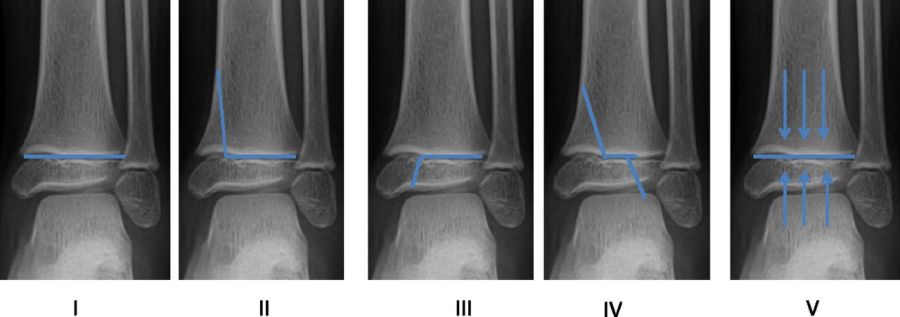
Memory aid: SALTR — Same (physis only), Above (metaphysis), Lower (epiphysis), Through (both), Rammed (crushed).
Type II — Thurston-Holland Fragment
The Thurston-Holland fragment is the metaphyseal corner fragment that remains attached to the epiphysis. It is pathognomonic of a Type II Salter-Harris fracture on XR.
SCFE — Slipped Capital Femoral Epiphysis
- Stable (can bear weight) vs. Unstable (cannot bear weight — higher AVN risk)
- Klein's line: a line drawn along the superior femoral neck on AP XR should intersect more than one-sixth of the femoral head. Failure to intersect = positive Klein's line = SCFE.
- Lateral view is most sensitive for early cases.
- Bilateral in 20–40% — always image the contralateral hip.