Ideberg Classification — Glenoid Fossa Fractures
| Type |
Description |
| 1a / 1b |
Anterior rim (1a) / posterior rim (1b) |
| 2 |
Transverse fracture to lateral scapular margin |
| 3 |
Transverse fracture to superior scapular margin |
| 4 |
Transverse fracture to medial scapular margin |
| 5a / 5b / 5c |
Combined transverse fracture patterns |
| 6 |
Comminuted crush of glenoid |
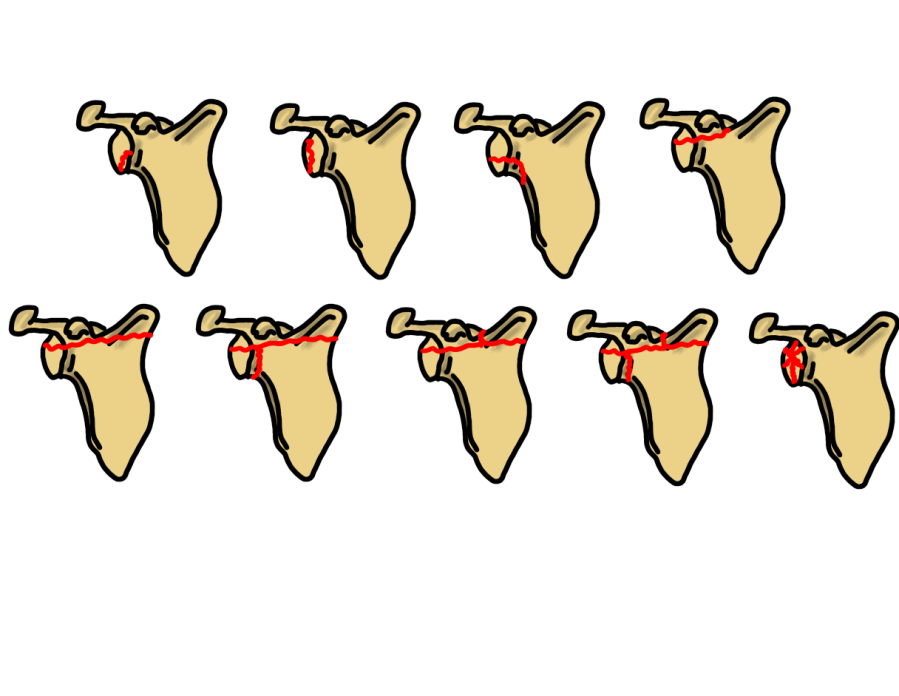 Ideberg classification — glenoid fossa fracture patterns
Superior Suspensory Complex (SSC)
The SSC is a bony and ligamentous ring providing stability to the shoulder girdle. It is composed of:
glenoid → coracoid → CC ligament → distal clavicle → AC joint → CA ligament → acromion
- 2 disruptions = unstable shoulder girdle → surgical
- 3 disruptions = floating shoulder
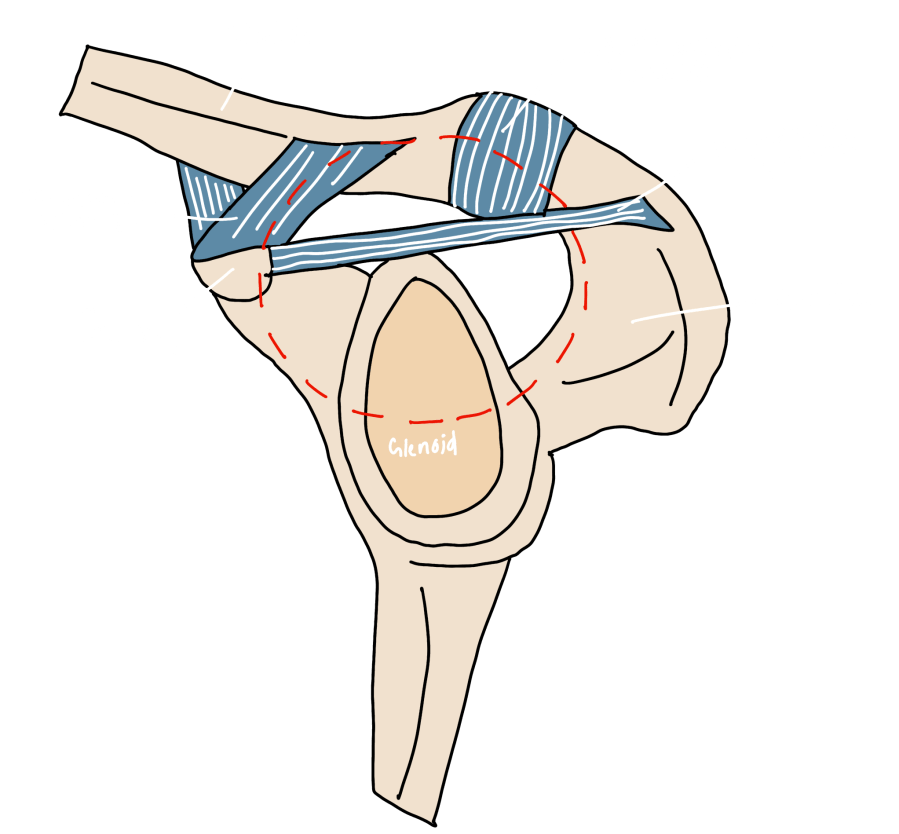 Superior Suspensory Complex (SSC) — bony and ligamentous ring of the shoulder girdle
Scapular Neck Fracture Classification
| Type |
Definition |
| Type 1 |
Nondisplaced |
| Type 2a |
Displaced — >1 cm translation |
| Type 2b |
Displaced — >40° angulation |
Acromion Fracture Types
| Type |
Description |
| Type I |
Nondisplaced |
| Type II |
Displaced |
| Type III |
Displaced with rotator cuff compromise |
Reporting Checklist — Scapular Fracture
- Scapular body: location, displacement, comminution
- Glenoid (Ideberg): articular surface involvement; step-off; Ideberg type (I–VI)
- Scapular neck: displaced (>1 cm translation = Type 2a) or angulated (>40° = Type 2b)
- Acromion: fracture type — I nondisplaced / II displaced / III with rotator cuff compromise
- Coracoid: fracture location (base vs tip); associated CC ligament disruption?
- Superior Suspensory Complex (SSC): tally disruptions — 2 disruptions = unstable/surgical; 3 disruptions = floating shoulder
- Associated injuries: rib fractures; pneumothorax or hemothorax; clavicle fracture; neurovascular injury
- Glenohumeral joint: dislocation or subluxation
More in RadCall
99+ guides, IR procedure playbooks, systematic search patterns, case logging, and wRVU tracking — all in one place.
Start free trial ›