Indications
| Indication | Clinical Context |
|---|---|
| Urinary obstruction | Calculi, malignancy (cervical, prostate, colorectal), ureteral stricture, retroperitoneal fibrosis, lymphadenopathy; obstruction must be confirmed — not hydronephrosis alone |
| Pyonephrosis (urgent) | Infected obstructed collecting system; sepsis; do not delay drainage for coagulation correction in the truly septic patient |
| Urinary diversion | Ureteral injury, fistula, or leak; post-surgical ureteral obstruction; radiation stricture |
| Portal for endourologic procedures | Access for percutaneous nephrolithotomy (PCNL), ureteral stent placement, antegrade ureteroscopy, rendezvous procedure |
| Diagnostic studies | Antegrade pyelography, Whitaker pressure-perfusion test for equivocal obstruction |
Contraindications
| Type | Contraindication |
|---|---|
| Absolute | Uncorrectable coagulopathy (in elective setting); note: in pyonephrosis with sepsis, life-threatening infection takes priority over coagulation optimization |
| Relative | INR >1.5 or platelets <50,000 (correct before elective cases); non-dilated collecting system (technically feasible but lower success rate, requires double-stick technique or diuresis); horseshoe, ectopic, or transplant kidney (modified approach required) |
Relevant Anatomy
Calyceal Access and Brödel's Line
The posterior lower pole calyx is the standard access target for percutaneous nephrostomy. This calyx is farthest from the renal hilum and collecting system, provides a straight working channel to the renal pelvis, and allows catheter placement below the level of the pelvis for dependent drainage. Brödel's line is the relatively avascular zone between the anterior and posterior renal vascular segments, approximately 1 cm posterior to the lateral convex border of the kidney — accessing along this line minimizes vascular injury.
The standard skin entry site is the posterior axillary line, below the 12th rib. Approach above the 12th rib is transpleural and substantially increases pneumothorax risk — avoid unless upper pole access is specifically required (e.g., complex stone anatomy). For transplant kidneys in the iliac fossa, an anterior approach under ultrasound guidance is used.
Danger Structures
The renal artery and vein enter at the hilum — lower pole posterior calyx access avoids these structures. Retrorenal colon is present in approximately 10% of patients on the left side — always review prior CT before access to confirm the colon is not retrorenal. The liver (right side) and spleen (left side) are superior and lateral — the posterior approach with rib awareness avoids these. The subcostal nerve and vessels run just below the 12th rib — approach from the inferior margin of the rib.
Pre-Procedure Checklist
Imaging Review
- CT or US to confirm degree of hydronephrosis, kidney location, collecting system anatomy, stone burden, and retrorenal bowel position
- Confirm obstruction is present — hydronephrosis without clinical or laboratory evidence of obstruction is not an indication
- Check for retrorenal colon on prior CT, especially on the left side
Labs and Pre-procedure Preparation
- CBC, basic metabolic panel, coagulation panel (INR, PTT, platelets); urine culture if available
- Target INR <1.5 and platelets >50,000 for elective cases
- IV antibiotics (ceftriaxone or gentamicin) at least 1 hour before procedure — non-negotiable for infected systems
- NPO minimum 4–6 hours for moderate sedation
- Non-dilated collecting system: consider IV diuretic before access to induce temporary diuresis and improve calyceal visualization under fluoroscopy
Consent Considerations
Discuss: hemorrhage (major ~1–4%; pseudoaneurysm and AV fistula), sepsis (especially with infected urine), pneumothorax (upper pole or above 12th rib access), organ injury (liver, spleen, colon), failure to access the collecting system, urinoma, post-obstructive diuresis (after bilateral or solitary kidney obstruction relief), and pain at the drain site.
Procedure Overview
The following is a high-level summary. Full step-by-step technique, double-stick technique, and troubleshooting are available in RadCall Pro.
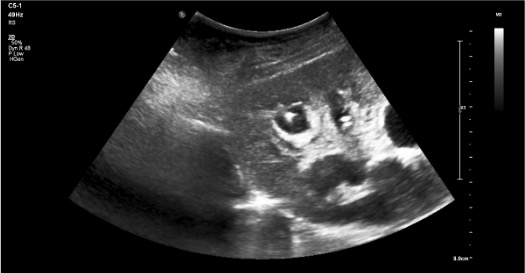
- Positioning and imaging survey — patient prone; US survey to confirm collecting system position, degree of dilation, and select target calyx (posterior lower pole preferred); measure skin-to-collecting system distance
- Sterile prep and local anesthesia — sterile prep; local anesthesia from skin to renal capsule under guidance
- Calyceal access — advance access needle to target calyx under real-time US guidance; confirm urine return; aspirate and instill equal volume dilute contrast to confirm position and opacify collecting system under fluoroscopy without overdistension (overdistension increases sepsis risk)
- Wire placement — advance wire into collecting system; confirm under fluoroscopy with coil in renal pelvis
- Tract dilation — exchange for working wire; serially dilate over wire to appropriate size for nephrostomy catheter placement
- Catheter placement — advance nephrostomy catheter over wire; coil pigtail in renal pelvis; release locking mechanism; perform completion nephrostogram — contrast should drain to ureter/bladder if unobstructed; confirms obstruction level
- Secure and connect — suture catheter to skin; connect to drainage bag; label bag with date and time
Complications
| Complication | Rate | Recognition & Management |
|---|---|---|
| Hemorrhage / perirenal hematoma | Major ~1–4% | Most clinically minor; CT for pain or hemodynamic instability; angiography and embolization for active arterial bleeding; pseudoaneurysm and AV fistula managed with selective embolization |
| Sepsis | ~5–10% within hours | Prevention with mandatory pre-procedure antibiotics; blood cultures; escalate antibiotics; ensure drain is functioning |
| Pneumothorax | Rare (below 12th rib approach) | Risk with upper pole access or above 12th rib approach; small — observation; significant — chest tube |
| Post-obstructive diuresis | 20–30% after bilateral or solitary kidney relief | High-volume urine output (>200–300 mL/hour) after decompression of prolonged bilateral obstruction; replace urine output volume with IV fluids; close monitoring for electrolyte abnormalities; avoid overcorrection |
| Bowel injury (retrorenal colon) | Rare (~0.2%) | Always review CT before access; small injuries with catheter through colon may be managed by withdrawing catheter incrementally as tract matures; surgical consultation for significant injuries |
| Failure to access | 2–5% (non-dilated systems) | Non-dilated system — double-stick technique or IV diuretic before access; general anesthesia and CT guidance for very complex anatomy |
Post-Procedure Care
Monitoring
- Vital signs every 30 minutes for 2 hours, then every 1 hour
- Urine output documentation — especially important for bilateral or solitary kidney obstruction (watch for post-obstructive diuresis)
- Drain output character: initial bloody output is expected and typically clears within 24–48 hours; persistent bright red output or hemodynamic instability warrants imaging
Drain Management and Follow-up
- Flush drain twice daily with saline to maintain patency
- Urology follow-up for definitive management of underlying obstruction
- Nephrostogram exchange typically every 3 months for long-term drains
When to Escalate
- Septic patient with pyonephrosis — urgent drainage; do not delay for coagulation optimization in hemodynamically compromised patient; accept acceptable risk and proceed
- Active arterial hemorrhage post-nephrostomy — urgent angiography and selective embolization; surgical backup for failed embolization
- Post-obstructive diuresis >200–300 mL/hour — aggressive IV fluid replacement; electrolyte monitoring; avoid over-replacement (can perpetuate diuresis); nephrology consultation for complex electrolyte management
- Catheter dislodgement — do not force blind reinsertion; reimaging to confirm collection status; IR re-access under imaging if catheter has fully dislodged and obstruction persists
References
- SIR Quality Improvement Guidelines for Percutaneous Nephrostomy. J Vasc Interv Radiol. 2016.
- Dyer RB, et al. Percutaneous nephrostomy with extensions of the technique: step by step. Radiographics. 2002;22(3):503–525.
- Kandarpa K, et al. Handbook of Interventional Radiologic Procedures, 5th ed.